
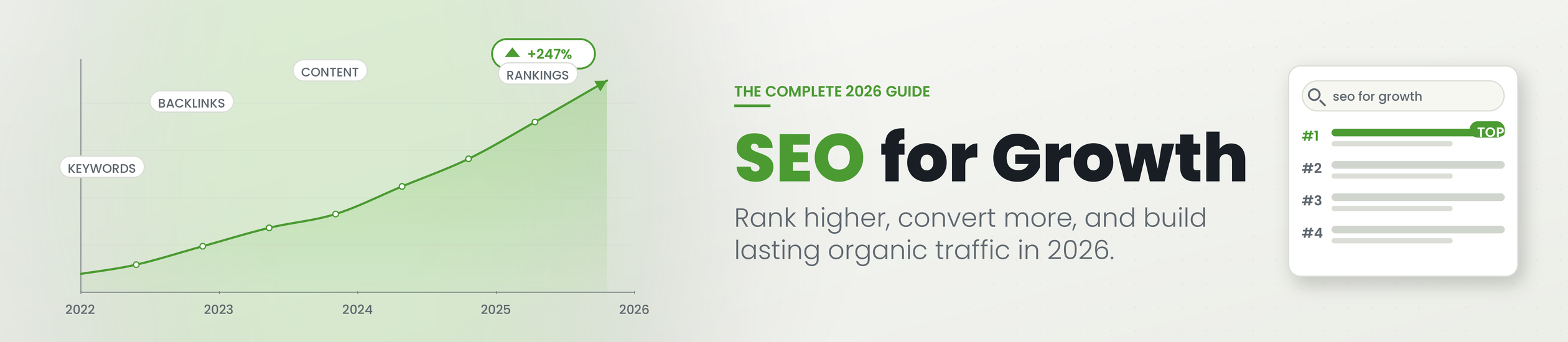
SEO for Growth – The Complete 2026 Guide
-
 Nathan Olnick
More traffic isn’t your problem.
See How We’d Grow Your Business → Get a Free SEO Strategy Call
After 20+ years and hundreds of SEO engagements across home service companies, medical practices, and e-commerce brands, we can say this with certainty: the businesses that struggle with SEO aren’t losing because of a traffic problem. They’re losing because they’re attracting the wrong people, converting at poor rates, and working with strategies that were never built for their specific market.
Here’s what we’ve consistently found: most SEO campaigns fail not because SEO doesn’t work, but because the strategy was never differentiated in the first place. Same keyword lists. Same templated service pages. Same generic link-building playbook handed to every client regardless of industry, market size, or competitive landscape. When everyone runs the same play, nobody wins.
This guide documents the exact framework we use at NO Marketing Agency — built from two decades of data, real client outcomes, and a fundamental refusal to treat any two businesses the same way.
What you’ll find here isn’t a survey of SEO best practices you could find anywhere. It’s a specific system for generating qualified leads and measurable revenue from organic search — one that’s been tested across industries, refined through results, and designed for brands serious about long-term growth.
If you’ve tried SEO before and felt like the needle never moved, this is why. And this is how we fix it.
What Is SEO in 2026?
SEO Has Changed
SEO is no longer about:
The tactics that cluttered agency playbooks for the past decade aren’t just ineffective today. Some are actively working against you.
Long-form content stuffed with keywords to satisfy AI Overviews and Google’s answers section is a dead end. Google has gotten exceptionally good at identifying padding disguised as expertise, and pages built around keyword density rather than genuine utility are being systematically filtered out of competitive results.
Link building from forum profiles, blog comments, and edu subdomains, or running mass-scale automation through tools like GSA, SENuke, or Article Marketing Robot, falls into the same category. These methods generate volume, not authority. Google’s ability to devalue manufactured links has made these tactics not just ineffective but a liability for any brand built to last.
Bought PBN links are another one. The term “Private Blog Network” means private. The moment you purchase links from someone else’s network, it is no longer private by definition. We run tens of thousands of test sites internally and can tell you directly: PBNs no longer move the needle in competitive niches. The risk to reward ratio simply does not hold up.
FAQ Schema is no longer worth building around. Google officially discontinued its use in the answers section on May 7th, 2026. Agencies still billing for FAQ schema as an SEO deliverable are selling you yesterday’s strategy.
Web 2.0 properties only work if they are properly charged, meaning built out with real content and legitimate links pointing to them. Most implementations skip this entirely and produce dead weight. The same applies to DAS Stacking, or Domain Authority Stacking. Without proper execution it creates a fragile structure that collapses under any meaningful algorithm update.
Finally, buying aged Reddit accounts to manufacture conversations and influence GEO or AEO is a waste of resources. And the idea that you can game AI search through planted content is fundamentally flawed. You have no control over how a person phrases their question to Claude, ChatGPT, or Perplexity. There is no set it and forget it play here. Anyone selling that is selling you fiction.
Today’s SEO is about:
Search intent is not a buzzword. It is the entire job. Every search query falls into one of four categories: Informational, Navigational, Commercial, or Transactional. When your content is built around the actual goal behind a query rather than just the words in it, you give Google exactly what it needs to rank you as a clear authority. You also stop users from bouncing because they landed on a page that did not answer their question.
Topical authority is how you become the definitive resource in your niche. Google measures this through semantic context, topic clusters, and its own E-E-A-T guidelines, which stands for Experience, Expertise, Authoritativeness, and Trustworthiness. That comes directly from Google. Covering a subject comprehensively and accurately, over time, is what earns that recognition from both search engines and real users. This is especially critical if your business operates in what Google classifies as a YMYL niche, which stands for Your Money or Your Life. These are categories where bad information can cause real harm: health and medical, financial services, legal advice, and major life decisions like buying a home or choosing a treatment plan. Google holds YMYL pages to a significantly stricter quality standard than general content. If you are a medical practice, a financial services company, a law firm, or any business operating in one of these categories, E-E-A-T is not optional. It is the baseline requirement for competing in search at all. Thin content, unverified claims, and anonymous authorship will not survive scrutiny in these niches regardless of how technically sound the rest of your SEO is..
And the direction Google is moving makes this even more important to understand. The algorithm is being tuned to reward authority, entities, freshness, behavioral validation, and continuously updated information systems. Static content is getting weaker every year. This is exactly why app stores have quietly become some of the most algorithmically favored environments on the internet. Every app page functions as a living document, with reviews, ratings, changelogs, developer responses, and dynamic rankings updating in real time. They have constant information gain, endless UGC, fresh behavioral signals, structured entities, and real world usage validation built in. AI retrieval systems are drawn to these environments because they are structured, validated, and constantly refreshed. Everyone is talking about Reddit powering AI Overviews. Almost nobody is talking about this. And you can build and publish a functional app faster than it used to take to write a single blog post.
Structured data, or Schema, is still one of the most underused tools in SEO when applied correctly. The right Schema on the right pages tells Google how to interpret your content and connects it to the Knowledge Graph, which influences Earned Results, Images, Google Business Profiles, Videos, and Service Offerings. The more accurate your citations and markup, the more it works across GEO and AEO. FAQ Schema is the exception, not the rule here, as Google removed it from the answers section in May 2026.
Topic clusters, whether blog posts or inner pages built around supporting subjects, are how you stand out as the top answer in your niche. One strong pillar page surrounded by related content that links back to it signals to Google that you own the subject, not just a single keyword. This is also why we run quarterly content update pipelines across every client engagement. Fresh, intent matched, and relevant is not a launch checklist item. It is an ongoing operating standard.
Guest posts still work, but not for the reasons most agencies pitch them. Domain Authority is a retired metric. Google dropped it. Directory Rank from Ahrefs, Trust Flow and Citation Flow from Majestic, none of these are signals Google uses to decide who ranks. Google has its own processes and algorithms. What actually matters is whether the site linking to you is ranking on page one, pulling more than 500 visits per month, has a clean link profile, and sits in a safe referring IP neighborhood. That means no porn sites, no spam, no bad actors sharing the same IP block. That is the standard we apply.
And every single one of those linking properties needs to be indexed. This is the most overlooked technical fundamental in SEO and the most expensive mistake we see on new client audits. If a page is not indexed it does not exist in Google search. It does not matter how strong the content is or how many quality links point at it. An unindexed page transfers zero authority and generates zero traffic. We have inherited accounts for a concrete company and a realtor where hundreds of quality backlinks were pointing at their domains and those pages had quietly fallen out of the index entirely. Their previous SEO teams told them indexation is up to Google. That is the wrong answer. Crawl budget is real, but that is an argument for managing it properly, not abandoning it. Every page you want to rank and every web property linking back to your domain needs to be crawlable, internally linked, actively submitted, and monitored on an ongoing basis. Pages fall out of the index regularly and for a wide range of reasons. When it happens we fix it immediately. We do not wait on Google.
For Google Business Profiles, which most local business owners still call Google Maps, the playbook is straightforward but almost nobody executes all of it. Citations built on authoritative sources, a fully completed profile, weekly posts, embedding the profile on your website, backlinks built directly to the GBP, real reviews from real customers, and the right Schema applied together. When all of it is done properly, local rankings move faster than most clients expect.
Key Takeaway
Gaming Google used to be a viable strategy. It is not anymore. The algorithm has been rebuilt around the same things a real customer wants: accurate answers, trusted sources, and brands that demonstrate they know what they are talking about. That is the entire game now.
This is even more true if your business operates in a YMYL niche. Health, finance, legal, and major life decision categories are subject to stricter algorithmic scrutiny because the consequences of bad information in these areas are real. Google is not going to rank a medical practice or a financial advisor on authority signals alone. The content has to be accurate, the authorship has to be credible, and the brand has to demonstrate genuine expertise at every level of the site.
And that starts with attracting the right audience in the first place. A domain and brand that clearly signal who you are, what you do, and who you serve will always outperform a generic one chasing broad traffic. Google is getting better every update at matching brands to the audiences they actually belong in front of. If your brand and domain do not reflect your niche, your market, and your expertise, you are starting every SEO campaign at a disadvantage before a single page is published.
Why Most SEO Campaigns Fail
Mistake #1: Chasing Rankings Instead of Revenue
Most businesses — and frankly, most agencies — fixate on where a website ranks for a handful of keywords. They celebrate hitting page one for a broad term and call it a win, even if the phone never rings.
Rankings are a leading indicator, not the destination. A plumber ranking #1 for “plumber” in a major metro is meaningless if the website doesn’t convert, if they’re attracting renters with no buying intent, or if the search volume doesn’t translate to calls.
What businesses should focus on instead: revenue-generating keywords with clear buying intent — terms like “emergency AC repair [city]” or “orthopedic surgeon accepting new patients near me” — combined with a website that’s built to convert that traffic into customers.
Mistake #2: Ignoring Google Business Profile
For local service businesses and medical practices, Google Business Profile (GBP) is often the single highest-ROI asset in your entire digital portfolio — and most businesses treat it like an afterthought.
The Map Pack (those three local results that appear above organic listings) gets a disproportionate share of clicks for high-intent local searches. If you’re investing in SEO and not aggressively optimizing your GBP, you’re leaving revenue on the table every single day.
Mistake #3: Weak Website Foundations
No amount of SEO effort can save a broken website. We see this constantly:
- Slow load times that cause visitors to bounce before the page even renders
- Poor mobile experience when the majority of local searches happen on phones
- No conversion tracking — flying blind with no idea what’s generating leads
- Weak service pages with no specificity, no trust signals, and no compelling reason to call
Mistake #4: No Authority Building
Google’s algorithm is built on trust. A website with no credible backlinks, no brand mentions, and no external validation is invisible — no matter how well-optimized the on-page elements are.
Distinctive brands earn authority. They earn it through genuine relationships, industry recognition, press mentions, and creating content worth linking to. There are no shortcuts that hold up over time.
Mistake #5: Not Tracking Your Top Competitors
Most agencies do competitor research once, at the start of an engagement, and never look at it again. That is a mistake we do not make.
We track our clients’ top five competitors continuously. Not monthly. Daily. What links are they earning, from what sites, and are those links actually indexed and carrying weight. What brand mentions are showing up on social media. What changes are happening on their site, both on-page content and technical infrastructure.
This is not paranoia. It is how you stay ahead in a competitive niche.
I once worked with another agency owner who asked why I was spending so much time on research like this. He had already gone through ten different SEO managers before working with us, and he still did not see the value in it. That tells you everything you need to know about why those ten previous engagements did not work.
If a competitor earns a powerful link, you need to know within a day, not a month later when they have already pulled ahead. If they change their site structure or shift their content strategy, that is signal. It tells you where the market is moving and gives you the chance to adjust before you are playing catch-up.
This is one of the simplest ways to stay ahead of competition, and almost nobody does it properly. Done right, it puts you in a position to lead your market, not just online, but in the real world too.
SEO Growth Framework
Your new website needs to be optimized—or enhanced —for search. There are some quick and easy ways that you can get in on the ground floor of quality SEO from Day 1.
Step 1: Market Research — Know Your Customer Before You Touch a Keyword
Before we write a single word of content or touch a single technical element, we do the work most agencies skip entirely: understanding the business, its ideal customers, and its competitive landscape at a deep level.
We identify:
- The ideal customer profile (ICP)— who they are, what they’re searching for, and what triggers them to make a buying decision
- True search intent — is this person researching, comparing, or ready to buy right now?
- High-value keyword opportunities — the terms that signal buying intent, not just curiosity. (I.E long-tail, high-intent search terms that directly drive sales, leads, and revenue, rather than just vanity traffic.)
- Competitive gaps — where competitors are weak, and how a distinctive brand can dominate. ((the difference between your business’s current performance, products, or marketing and what your top competitors offer)
The questions we answer in this phase:
- What are customers actually searching for when they’re ready to hire or buy?
- What problems are they trying to solve, and how do they describe those problems?
- Which keywords indicate someone is at the bottom of the funnel (BOFU) and ready to act?
This research shapes every decision that follows. It’s why our strategies don’t look like everyone else’s
Step 2: Technical SEO — Build a Foundation Google Can Trust
A technically sound website is non-negotiable. We conduct a comprehensive technical audit and resolve every issue that could limit a site’s ability to rank or convert. Most agencies generate a report and hand it to a developer. We execute, because most growth gaps in SEO are not strategic, they are operational.
- Indexation management is where we start. If a page is not indexed it does not exist in Google search, and this applies to every page on your domain and every web property linking back to it. We audit indexation status across the entire site, submit pages correctly, and monitor ongoing indexation health. When pages fall out of the index we fix it immediately. We do not wait on Google.
- Page naming conventions and URL structure are addressed before anything else is built or optimized. Clean, descriptive URLs that reflect the content hierarchy tell Google and users exactly where they are on the site. Keyword rich, readable URLs outperform generic string based ones every time.
- Site architecture and navigation are audited and structured so that both users and search engines can move through the site logically. A flat, well organized structure ensures that authority flows efficiently from the homepage down through every category and service page. Breadcrumbs are implemented to reinforce that hierarchy, support internal linking, and give Google additional context about how pages relate to each other.
- Click depth is reviewed across the entire site. Any page that matters for rankings or conversions should be reachable within three clicks from the homepage. Pages buried deeper than that get crawled less frequently and accumulate less internal authority.
- Crawlability and crawl budget management go beyond just making sure Googlebot can access the site. We analyze log files to see exactly how Google is crawling the domain, where it is wasting budget on pages that should not be crawled, and what it is ignoring that should be getting attention. Almost no agency does this. It is one of the most revealing audits we run.
- The robots.txt file is reviewed and configured correctly. Blocking the wrong pages wastes crawl budget. Leaving the wrong pages open invites indexation of content that should never rank.
- The .htaccess file is audited for redirect rules, access controls, and any configurations that could interfere with crawling, indexation, or site speed. Errors here can silently break large portions of a site.
- WWW versus non-WWW is standardized and enforced with a proper 301 redirect to a single canonical version. Running both versions without a redirect splits authority and creates duplicate content at the domain level.
- Canonical tags are implemented correctly across the site to eliminate duplicate content issues caused by URL variations, pagination, session parameters, and tracking strings. Duplicate content does not just confuse Google, it splits authority across multiple versions of the same page and suppresses rankings across all of them. Rel prev and next pagination signals are implemented where applicable to help Google understand paginated content correctly.
- Cookies and session IDs in URLs are identified and resolved. When session parameters get indexed they create thousands of duplicate URLs that consume crawl budget and dilute authority.
- URL rewriting is configured so that dynamic URLs are converted into clean, static-looking structures that are readable by both users and search engines.
- Header status codes are audited across the site. Every page should return the correct response code. Soft 404s, redirect chains, and pages returning 200 status codes when they should not are identified and corrected. Error codes flagged in Google Search Console are prioritized and resolved systematically.
- XML sitemaps are submitted, kept accurate, and updated as the site grows. An outdated or bloated sitemap is a crawl budget problem waiting to happen.
- Redirect management is audited and cleaned up. Broken redirect chains, 404 errors, and improper 301 handling bleed authority and create unnecessary crawl waste. Every redirect in the chain costs something.
- Thin content and duplicate content flags are identified and resolved. These are active ranking suppressors that show up on almost every audit we inherit from a previous agency.
- Core Web Vitals cover loading speed, interactivity, and visual stability. But the real work is what sits underneath those scores: image compression, server response time, render blocking scripts, caching configuration, and hosting quality. A good CWV score is the outcome. These are the actual levers.
- Mobile usability is verified across devices, not just checked against Google’s mobile friendly test. The majority of local searches happen on phones and a poor mobile experience is a direct conversion killer regardless of how well the page ranks.
- HTTPS implementation is verified end to end. Any mixed content issues, expired certificates, insecure elements, or improper HTTP to HTTPS redirect configurations are resolved as part of the foundation audit.
- Schema markup is implemented for entity matching and Knowledge Graph signals across the relevant page types: service pages, local business, reviews, videos, products, and blog posts. FAQ Schema is not included as Google removed it from the answers section in May 2026.
- Internal linking architecture is built to distribute authority across the site strategically, connect topic clusters to their pillar pages, and ensure that the pages generating the most value are getting the most internal equity.
Step 3: Content That Converts
Content is where most SEO strategies look identical. Everyone writes the same service page, targets the same keywords, and ends up buried beneath competitors who’ve simply been doing it longer.
Our approach is different. We build content architecture around how real customers search and make decisions, not around what’s easiest to produce.
We create:
- Core service pages — authoritative, conversion-optimized pages for each primary service
- Location + service pages — city-specific pages that dominate local searches for high-intent queries
- Problem-based pages — content targeting searches like “why is my AC not cooling” or “what to do after a car accident” that capture customers earlier in their journey
- FAQ and supporting content — answering real questions that build trust and topical authority
Our content philosophy: Every page should either rank, convert, or both. If it doesn’t serve one of those two purposes, it doesn’t get published.
Step 4: Google Business Profile Optimization
For home service companies, medical practices, and local businesses, the Map Pack is prime real estate. Studies consistently show that the top three local results capture the vast majority of clicks for searches like “HVAC repair near me” or “urgent care open now.”
A fully optimized, actively managed GBP is one of the most powerful competitive advantages available — and most competitors are doing the bare minimum.
Our GBP optimization process covers:
- Primary and secondary categories — selected strategically, not randomly
- Services and service descriptions — fully built out with keyword-rich, accurate descriptions
- Photos — high-quality, regularly updated images of your team, vehicles, and work
- Review generation and response strategy — building and maintaining a strong review profile
- Weekly posts — keeping the profile active and signaling relevance to Google
- Q&A management — pre-populating answers to common questions
- Products (where applicable) — leveraged for e-commerce and service-based businesses alike
- Citation consistency — ensuring NAP (name, address, phone) data is accurate across the web (This is not absolute but trying to take care of it where you can)
Step 5: Authority Building
Backlinks remain one of Google’s most important ranking signals — but the tactics that worked a decade ago don’t just fail today, they can actively hurt a business.
What works in 2026:
- Earning links through genuinely useful, industry-specific content
- Local and industry directory placements with real traffic and relevance
- PR and media coverage in trade publications and regional outlets
- Strategic partnerships and sponsorships that generate natural mentions
What doesn’t work:
- Buying links from link farms or private blog networks
- Mass-scale guest posting with no editorial standards
- Irrelevant directory submissions designed purely for volume
Our backlink strategy is built on one principle: earn links that a real business would naturally earn. Google is exceptionally good at identifying manufactured authority, and the risk is never worth it for brands built to last.
Step 6: Conversion Optimization — Because Traffic Without Conversions Is Just a Vanity Metric
Ranking well and generating traffic means nothing if visitors don’t convert into customers. Every SEO engagement we run includes conversion optimization, because a leaky funnel undermines everything else.
Our conversion checklist:
- Clear, compelling CTAs — above the fold, on every page, with zero ambiguity about what to do next
- Click-to-call functionality — especially critical for mobile users in home services and healthcare
- Lead capture forms — short, friction-free, and strategically placed
- Trust signals — licenses, certifications, awards, and affiliations prominently displayed
- Review integration — Google reviews and testimonials woven throughout the site
- Service guarantees — clear statements that reduce perceived risk
Our philosophy: A great SEO strategy that sends traffic to a poor website is a waste of everyone’s time and money. We fix the funnel before we pour traffic into it.
The 2026 SEO Ranking Factors That Actually Matter
Factor #1: Search Intent
Google’s primary job is to match the right content to the right searcher. Pages that precisely match what the searcher is trying to accomplish — not just the keywords they typed — consistently outperform pages optimized purely for terms. Understanding and designing for intent is the foundation of everything.
Factor #2: Topical Authority
Google increasingly rewards websites that demonstrate comprehensive expertise in a specific subject area. A plumbing company that covers every aspect of residential plumbing thoroughly — from water heater installation to slab leak repair to drain cleaning — signals authority in a way that a single-page website never can.
Factor #3: Brand Signals
Google pays attention to whether a brand exists beyond its website. Search volume for your brand name, mentions across the web, social media presence, and press coverage all contribute to how much Google trusts your domain. Distinctive brands with real audiences have a structural advantage.
Factor #4: User Experience
Core Web Vitals and user behavior signals — bounce rate, time on site, pages per session — tell Google whether real people find your website useful. A technically fast, well-structured, genuinely helpful website earns better rankings over time.
Factor #5: Local Signals
For businesses serving a geographic area, proximity, review quantity and quality, citation consistency, and GBP completeness all influence local rankings. The Map Pack and local organic results operate on their own set of signals, and they require a dedicated local SEO strategy.
SEO Timeline: What to Expect
| Timeline | Milestones |
|---|---|
| Month 1 |
|
| Months 2–3 |
|
| Months 4–6 |
|
| Months 6–12 |
|
How We Measure SEO Success
Rankings are a checkpoint, not the destination. We track the metrics that connect directly to business outcomes:
- Organic traffic — total and by page/keyword category
- Leads generated — form submissions, phone calls, chat initiations
- Phone call tracking — volume, source, and call quality
- Google Business Profile performance — searches, views, calls, and direction requests
- Revenue attributed to organic search (where tracking allows)
- Rankings — monitored as a leading indicator, not a vanity metric
The most important metric: qualified leads and revenue generated from organic search. Everything else is context.
SEO Red Flags: How to Spot an Agency That Will Waste Your Budget
In 20+ years in this industry, we’ve seen the same damaging patterns repeat. Avoid any agency that:
- Guarantees a #1 ranking — no ethical agency can guarantee specific rankings; Google controls the algorithm
- Won’t explain their strategy — opacity is a red flag for tactics that won’t hold up
- Reports only on rankings without connecting them to leads or revenue
- Uses the same strategy for every client — a medical practice and a plumbing company have nothing in common; their SEO shouldn’t either
- Disappears after onboarding — no communication, no proactive updates, no accountability
- Can’t show you real results from real clients in comparable industries
- Sells cheap SEO — sustainable SEO requires real expertise and real work; predatory pricing reflects neither
Why Growth-Minded Businesses Invest in SEO
Paid advertising stops the moment you stop paying. SEO compounds.
A business that builds genuine organic authority creates a durable, appreciating asset that generates leads at a fraction of the cost-per-acquisition of paid channels. The businesses we’ve worked with over two decades that committed to long-term SEO consistently outperform competitors in customer acquisition cost, lead quality, and overall marketing ROI.
The additional benefits are significant:
- Consistent, predictable lead generation that doesn’t fluctuate with ad spend
- Higher perceived trust — consumers trust organic results more than ads
- Competitive moats — organic authority is difficult and slow to replicate
- Lower customer acquisition costs over time as the investment compounds
- A real long-term asset that increases in value as the business grows
The businesses we’ve seen struggle with SEO weren’t patient enough, weren’t strategic enough, or chose partners who weren’t capable enough. The businesses that dominate their markets through search made a commitment to doing it right.
Final Thoughts
SEO isn’t about getting more visitors.
It’s about attracting the right people, converting them into customers, and building the kind of digital authority that your competitors can’t easily take away.
The businesses that dominate search in 2026 will be the ones that invest in strategy over shortcuts, commit to differentiation over cookie-cutter execution, and partner with people who are accountable for outcomes — not just activity.
At NO Marketing Agency, we’ve spent 20+ years building SEO strategies for distinctive brands that don’t want to look like everyone else in their market. We work with HVAC companies, plumbers, home service businesses, medical practices, and e-commerce brands that are serious about growth — and serious about working with a team that’s serious about results.
If you’re ready to grow your business through a proven SEO strategy built specifically for your brand and market, let’s talk.
NO Marketing Agency
See what's actually
holding your rankings back.
holding your rankings back.
Enter your domain and get a live snapshot of your organic visibility, keyword footprint, and the single biggest opportunity your competitors are exploiting right now.
Step 1 — Enter your website
Live data · results in ~15 seconds
20+
Years
500+
Businesses
Free
No signup
Enter a valid domain — e.g. yourbusiness.com
Fetching domain data
Pulling top keywords & rankings
Checking technical signals
Generating your surface review with AI
Top ranking keywords
Technical signals
20-year surface review — NO Marketing Agency
Get the full growth plan
30-min strategy call. We walk through your data live and build a 90-day roadmap.
Analysis: NO Marketing Agency · nomarketingagency.com
Share:
Facebook
Twitter
Pinterest
LinkedIn
Nathan Olnick
Table of Contents
On Key
Related Posts


